

Biofeedback

Understanding Mind-Body Connections and How Biofeedback Can Help
Psychophysiology is the study of how our minds and bodies are connected. This field of study is present in many places—clinics, schools, sports, businesses—because knowing how our thoughts and feelings affect our bodies can make a difference in our health, learning, and performance. Psychophysiology uses non-invasive approaches to evaluate how our body maintains balance, how our body reacts to emotional or cognitive triggers (such as fear or relaxation techniques) and how we may respond emotionally when our body feels a certain way (increased heart rate triggering fear).
Applied Psychophysiology takes this mind-body knowledge and puts it into practice. It uses knowledge about how mind-body interactions should be to develop and apply techniques for increasing awareness of these relationships for either educational or clinical purposes. The goal is to help people become more aware of how their minds and bodies interact, and to use that awareness for real-life improvements—whether in managing stress, learning, or overcoming health challenges. Relaxation training and cognitive restructuring are techniques of applied psychophysiology that don’t require equipment.
Biofeedback devices are instruments used in applied psychophysiology. Here’s how it works: “Precise instruments measure physiological activity such as brainwaves, heart rate, heart rate variability, muscle tension, breathing, and skin temperature. These devices instantly “feedback” the information to the user. The presentation of this information — often in conjunction with changes in thinking, emotions, and behavior — supports desired physiological changes. Over time, these changes can endure without continued use of an instrument.” (Definition by Association for Applied Psychophysiology and Biofeedback (AAPB); Biofeedback Certification Institute of America (BCIA); The Foundation for Neurofeedback and Neuromodulation Research (FNNR, formerly ISNR))
You are probably aware of consumer products such as the Oura Ring or Whoop Technology. These are biofeedback devices that provide you a summary of various physiological markers gathered overtime and the companies provide you with ways to interpret the overall scores. Your Apple or Samsung watches provide your heart rate in real time, allowing you to see you current beats per minute (BPM), resting heart rate, or be alerted to any irregularities in your heart rate. These devices are not intended to be clinical, but educational for the public.
Our Approach
Optimal Moments utilizes more precise biofeedback equipment that allows the therapist to monitor a client’s physiology in real time allowing the client to recognize what is going on in the body and assess how well strategies are working to manage physiological activity. This allows the client and therapist to see immediately (1) the level at which the client’s physiology is functioning and (2) changes in physiological activity. For instance, when you are practicing relaxation techniques, the therapist can assess if your body is entering a relaxed state. You are taught how to have better control over your body. Combining biofeedback with relaxation techniques gives you a double boost in learning how to calm down, focus, or gain better control over your health and well-being.
Talk with your clinician about how biofeedback can be used in conjunction with therapy. Talk with Dr. Sadberry if you would like to a presentation to your organization about biofeedback.
Common Uses:
Treatment of Clinical Problems:
Tension Headaches and Migraines
Stress / Anxiety
Panic Attacks
Sleep Problems
Anger Management
Chronic Pain
Stress Labile (Essential) Hypertension
Irritable Bowel syndrome
Stress Related Muscle Pain in the jaws, low back, and shoulders
Education:
Decreasing test anxiety
Increasing focus for learning
Performance Enhancement:
Sports, business and military activities
THOUGHT TECHNOLOGY:
Thought Technology is powerful biofeedback equipment that Dr. Sadberry uses to do stress profile assessments, to address clinical concerns, and for peak performance. You can learn more about this equipment here.
It measures the following physiological markers:
Respiration: Breathing ratio changes when stressed versus when relaxing. Many people are not breathing fully and completely into their lungs. A common response to stress is chest tightness and breathing constriction.
Muscle Tension (sEMG – surface electromyogram): This is usually measured on the trapezius muscle or forehead.
Skin Temperature: Surprisingly, when you are stressed or anxious you release heat, thus your temperature will go down. Whereas, when you are relaxed, your temperature will increase.
Heart Rate: This measure your heart beats per minute. When you “breath in” your heart rate speeds up and when you “breath out” your heart rate slows down.
Sweating (GSR): Sweating is largely controlled by the sympathetic nervous system so this is a great way to pick up changes in sympathetic activity. Sweat is mostly salt water – which conducts electricity, which is how we are able to measure
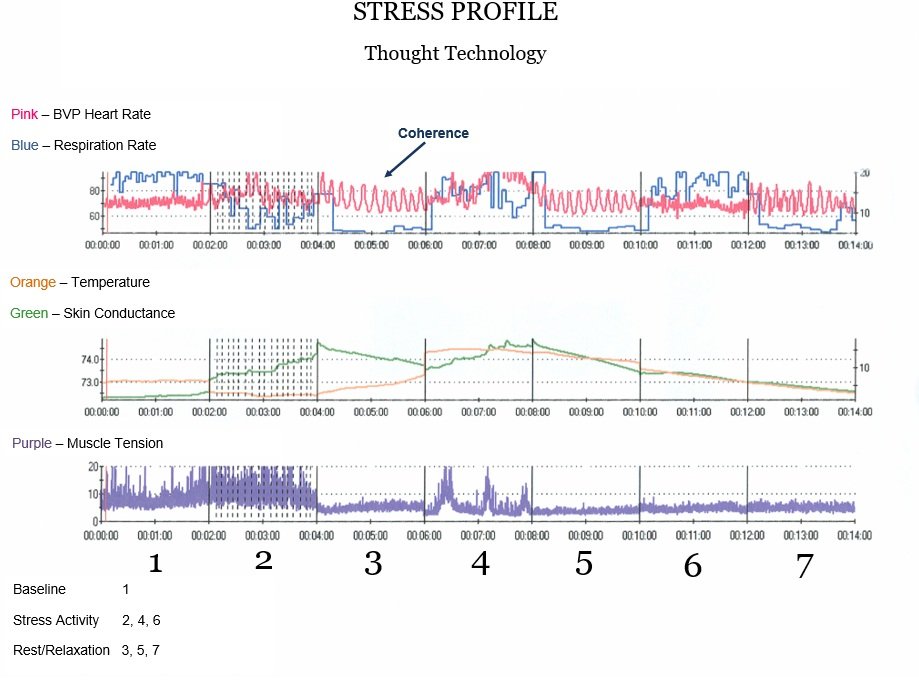
Heart Rate Variability (HRV): This is the time interval in between heart beats. It is related to the ratio of sympathetic/parasympathetic activity. Bringing your HRV into “coherence” simply means your sympathetic and parasympathetic systems are oscillating in a stable, rhythmic pattern over a period of time. When HRV is in coherence, there also tends to be increased coherence between the rhythmic patterns produced by different physiological oscillatory systems (e.g. heart rhythms, respiratory rhythms and blood pressure oscillations).
Ultimately, the goal is to help you control the mind-body connection, leading to you feeling awake, alert, and relaxed. You have heard this as being “In the Zone”!
Here is an example of a stress profile. Dr. Sadberry’s to be exact. You will notice the change from Baseline (Column 1) to a Stress Activity (Column 2) to a period of intentional Relaxation. You can clearly see the HRV is in Coherence!
HEARTMATH:
Heartmath is another biofeedback device we use at Optimal Moments. All clinicians are trained on this equipment and can utilize it in conjunction with therapy. It focus on Heart Rate (HR) and Heart Rate Variability (HRV) only. This equipment is also sold to the public here. Remember this is different than the Oura Ring or Whoop Technology or any of the other devices that provide you a summary score. This device will give you real time immediate feedback, allowing you to see the changes that can happen to HRV when you implement the techniques you are learning in therapy and allows you to improve your focus. It provides a unique game-like experience as you attempt to get In the Zone.
In the clinical setting, we are able to utilize this equipment to address specific concerns, practice relaxation techniques, and emotional awareness. Talk with your therapist today if you want to explore how biofeedback can be used in treatment!



Why did you choose this field? Follow us as we dive into the student perspective as Ayotorimide Ariyo answers this question.